When Code Is Cheap, What Do You Ship?
Snap cited AI coding tools in a layoff memo for a thousand people. The memo was not wrong. This article is about where the value of engineering actually lives when AI writes most of the code.
 Nadim A. Massih28 May 2026 · 8 min read
The Number in the Layoff Memo
On 15 April 2026, Snap fired about a thousand people. Sixteen per cent of the company. Gone in a memo.
The memo did something unusual. It told the truth.
Most layoff notes hide behind weather words. Headwinds. Realignment. A challenging macro environment. Snap’s chief executive skipped all of that and named the cause out loud: AI agents now generate more than 65% of the company’s new code, and small squads using AI tools can do the work that used to need larger engineering teams (CNBC, 2026).
Then the part nobody could have scripted. The stock went up. Around eight per cent.
Read that sequence again. A company says machines now write most of its software, says it therefore needs far fewer humans, and the market rewards the confession. A sceptic will say the stock went up because Snap has been burning cash for years and the market simply applauded any sign of discipline. That reading is not wrong. But it misses what was actually being priced: not the headcount reduction, but the named cause attached to it. The layoff was not the bad news. The layoff was the proof of concept. (
The layoff was not the bad news. The layoff was the proof of concept.
Worth noting: the roles Snap actually cut were in product and partnerships, not engineering directly. Spiegel named engineering efficiency as the reason; the redundancies landed elsewhere. That gap between stated cause and actual cuts is precisely why the sceptics in this piece deserve a hearing.
The question the memo raises is the right one: if AI writes the code, what does the engineer write?
To answer it properly, it helps to look at what AI can actually do for an engineer right now, in 2026.
That is the entire story. Everything else in this piece is evidence for it, or implication from it.
The Deliverable Moves Up the Stack
The code was never the valuable part, not for most teams.
The code was the toll you paid to find out whether your judgement was right. Now the toll is cheap.
“The code was the toll you paid to find out whether your judgement was right. Now the toll is cheap. The judgement is worth more.”
Nadim A. Massih · Patient Comet · 2026
This is not the first time a craft's tooling got cheap. It happened to photography when digital arrived; to music production when software replaced the studio; to design when templates made layout trivial. Each time, the commodity layer collapsed and the layer above it (the judgement, the eye, the taste) became the thing that separated people who were genuinely good at it. Software is the latest version of that pattern.
For thirty years, the scarce and defining act of building software was the writing of it. The code was the work. You hired for it, you queued for it, you protected the people who could do it.
That bottleneck is dissolving. Google says 75% of its new code is now AI-generated and approved by engineers (Google/Fast Company, 2026); Microsoft puts its figure at 20 to 30% (Microsoft, 2025); Snap is past 65% (CNBC, 2026). Roughly three in four developers now reach for an AI tool as a matter of course (Stack Overflow Developer Survey, 2024). The act that used to be the job is becoming the cheap part of the job.
Most teams are not at 65 or 75 per cent yet. But the direction is not in question, and preparing now (before the transition arrives at your organisation) is the entire point.
So where did the value go?
Most people get this wrong in the same direction. They assume that when the cost of code collapses, the value collapses with it. The opposite is happening. The value did not vanish. It moved, up the stack, to the things the model cannot do for you: deciding what to build, knowing whether it is any good, specifying it precisely enough that an agent can execute it, and getting it in front of the right people.
What is left exposed is the engineering. Items eleven through fifteen (the understanding, the decisions, the reliable systems, the communication with humans) were always the job. Now they are the only part of the job that compounds in value as the tools get cheaper.
IBM CEO Arvind Krishna has described what he calls the $8 trillion math problem: reaching 100 gigawatts of global AI compute requires $8 trillion of capital expenditure (at roughly $80 billion per gigawatt), committed entirely to making items 1 through 10 faster and cheaper. Not one watt of those data centres makes items 11 through 15 easier to do (Futurism / IBM, 2025).
The return data confirms the gap. Goldman Sachs calculates that sustaining current investor return expectations requires AI companies to generate more than $1 trillion in annual profit from their AI infrastructure. By 2026, the industry consensus tracked by Goldman Sachs had reached around $450 billion in annual AI revenue: roughly $0.45 back for every $1 of capital expenditure (capex) (Goldman Sachs, 2024). The report named the problem plainly: “too much spend, too little benefit.” The DORA 2026 developer research programme found the missing variable: strong engineering foundations are what actually drive AI return on investment. The organisations seeing real returns are the ones with mature practices in the things AI cannot do: requirements, decisions, reliable systems.
Cheap to Write Is Not Cheap to Own
Those numbers describe where the value actually lives, and it is not in the production layer.
Cheap to write is not the same as cheap to own. This is not a theoretical concern: the evidence is in, and it is not flattering. The cost of code did not disappear when the typing got fast. It relocated, downstream, to review, to maintenance, to the slow tax of running software nobody on the team fully understands.
CodeRabbit (a code review analytics platform) found that AI-co-authored pull requests (bundled sets of code changes submitted for review) carried about 1.7 times more issues than human-only code, with security problems up to 2.7 times worse (CodeRabbit, 2025). The code arrives faster, and arrives carrying more of the kind of problem you do not see until later.
The code arrives faster, and arrives carrying more of the kind of problem you do not see until later.
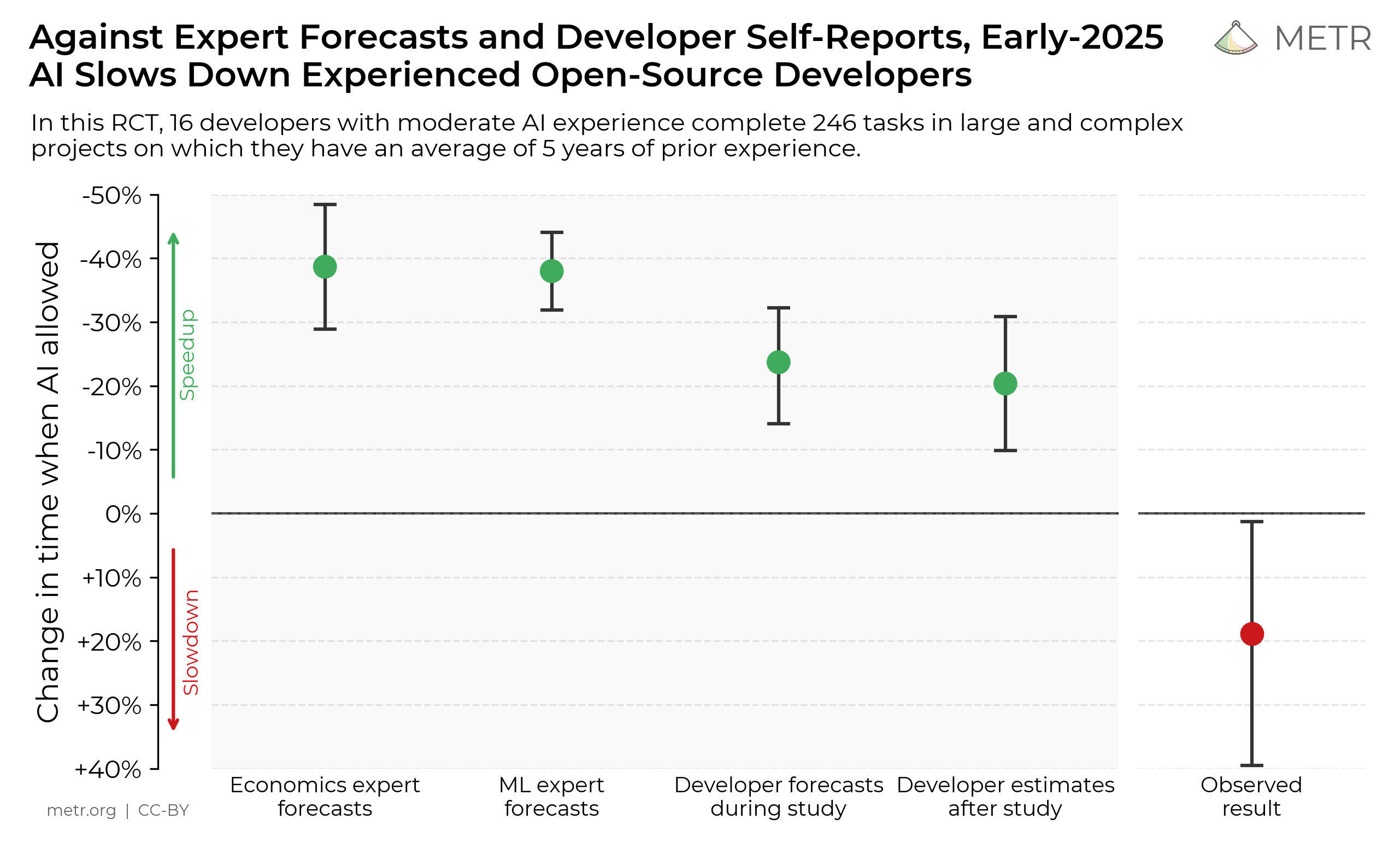
Then the part that should unsettle you. A controlled trial (sixteen experienced developers, 246 tasks, randomised assignment) put developers on code they knew well. With AI, they were about 19% slower (METR, an AI evaluation safety research organisation, 2025). Not faster. Slower. And they believed they were faster the whole time. The tool did not just cost them time. It cost them the ability to notice they were losing it, which is a different kind of problem entirely.
A large industry study found the pattern underneath: AI raises throughput (the rate at which code ships) and worsens delivery stability (DORA, the annual industry developer research report, 2025). It does not fix your team. It amplifies whatever your team already is. Disciplined shops get a multiplier. Sloppy ones get a faster way to ship the mess. There is a name worth keeping for the bill that comes due here: comprehension debt, the accumulating cost of shipping code nobody fully understands. You take it on quietly, at speed. You repay it all at once, in production, on the worst possible day.
The Apprenticeship Needs a New Curriculum
The cost moved. The work moved to higher ground. What about the people?
Stanford Digital Economy Lab found that employment for early-career developers, the ones aged 22 to 25, is down about 20% since AI went standard (Stanford, 2025). Not redistributed. Down. The roles that contracted fastest were the ones closest to items 1 through 10: take a clear ticket, write the obvious implementation, hand it back. That is exactly what an agent now does for nothing.
76% of developers cite incomplete or unclear requirements as the primary blocker when working with AI coding tools, making requirements-gathering the constraint on whether AI delivers any value at all (Stack Overflow Developer Survey, 2024).
But look at what is expanding. The roles companies cannot fill fast enough are the ones requiring items 11 through 15: the technical lead who can run a requirements session, the senior engineer who can debug production without a map, the architect who makes good decisions under real ambiguity.
The apprenticeship is not being automated away. It is being rebuilt around a different curriculum. The path forward for early-career engineers is not to compete with AI on items 1 through 10. It is to use those tools to compress the routine work and invest the hours saved into items 11 through 15. The engineers who do that now are not behind the curve. They are the curve. The transition has not arrived everywhere yet.
Items 11 through 15 are where the work now lives. If you run a team that ships software, four moves follow.
Make the spec the deliverable
A spec is a written description of what software should do and why, before anyone writes a line of code. Stop treating it as paperwork on the way to the real thing. The spec is now the real thing, the artefact you track and protect. GitHub’s Spec Kit (a tool for writing structured specifications before any code is written) makes this literal, and once the spec is solid the agents underneath become interchangeable.
Product & engMove people from author to verifier
The old senior wrote the hard code; the new senior reads everything and decides what is true. That is a different muscle, and most teams have let it atrophy. Train for it on purpose, because the scarce skill is now judging a diff (the specific lines of code that changed) a machine wrote, fast, and knowing whether it is right.
EngineeringMove people up, not out
Snap moved people out, and the market clapped, but that answer eats your own future. The harder, better one is to move people up the stack faster than the machine eats the bottom of it: into problem definition, into taste, into judgement.
LeadershipMake distribution and taste the moat
When anyone can produce working software in an afternoon, the software is not the moat. Knowing what to build, building it with taste, and getting it to the right people are the three things the model still cannot do. Spend your scarce human attention there.
A dedicated piece will go deep on what taste is at the craft level, and why it compounds the cheaper the tools get.
StrategyThose four moves assume you believe the shift is real and the direction is set. Not everyone does. Three people are arguing about all of this, and they are all partly right, and you should hear them before you decide which side to stand on.
Three Roles Worth Understanding Now
Three ways to read the shift, each based on the evidence above.
A controlled trial found experienced developers 19% slower with AI, on code they knew well. And they believed they were faster the whole time. The tool did not just cost them time. It cost them the ability to notice. A productivity revolution you cannot measure is a story, not a result, so measure your real cycle time (how long it actually takes from starting a feature to shipping it) before you believe the headline (METR, 2025).
AI pull requests carry about 1.7 times more issues, security problems multiply, and the bill is deferred, not cancelled. The code is cheap to produce and expensive to live with, and comprehension debt compounds in the dark (CodeRabbit, 2025).
It does not fix a team, it magnifies what is already there: strong teams pull ahead, weak ones get worse, and stability degrades without discipline. Real, and good, but only for teams disciplined enough to deserve it. For everyone else, a faster way to be exactly what you already were.
Technology Changed. Engineering Did Not.
Technology changed. Engineering did not. That is good news, if you know what engineering actually is.
The $8 trillion going into AI data centres is the largest public signal the industry has ever sent about where the scarce value sits. Every dollar of it is chasing items 1 through 10. Not one of those dollars makes items 11 through 15 easier to do. Which means the investment, read correctly, is pointing directly at engineers who understand requirements, who can debug production, who make good decisions, who communicate with humans, who build systems that actually hold (Futurism / IBM, 2025).
The companies reading the Snap memo as a headcount story are reading it wrong. The right reading: when the commodity layer gets cheap, what remains is what was always underneath it. And what was always underneath it was engineering. The $8 trillion is not a threat to the craft (Futurism / IBM, 2025). It is a searchlight illuminating where the craft lives.
One thing to do this week: take the next feature on your list and write what it needs to do and why, before anyone writes a line of code. Then review the result against that intent, not against the lines themselves. That single habit is the gate between an engineer who feeds the machine and one who decides what the machine builds. It has always been the gate. Now it is the only one that matters.
If you are an individual engineer rather than a lead, the same signal runs one level down. Items 11 through 15 are not team-level abstractions: they are what you do every day when you are doing engineering well. Invest in them now, explicitly, before everyone else realises they are scarce.
If you are early-career: this is the best career news you have had. The path to compound value runs through items 11 through 15. Use the tools to handle items 1 through 10. Invest the hours you save into learning to understand requirements nobody else can articulate, to debug systems nobody else can read, to make calls nobody else wants to own. Those skills do not get automated. They get scarcer, and more valuable, as every new model makes items 1 through 10 cheaper.
- Write the next feature as a spec. What and why, with acceptance criteria, before any code.
- Review against the spec, not the diff. Judge whether it does what you meant, not whether the lines look plausible.
- Reinvest the saved hours in verification. Testing, version control, small batches, real review.
- Move juniors into specifying, not out the door. That is where the next seniors come from.
- If you are early-career: use items 1 through 10 to compress your learning time, then invest every hour saved into items 11 through 15. The engineers who compound from here are the ones who get to requirements before anyone writes a ticket. That is not a new job description. It is the original one.
The $8 trillion going into AI infrastructure is not a threat to engineers who know their craft. It is a searchlight pointing at exactly where the craft lives, and always lived.
NWritten byNadim A. MassihAI & Tech StrategistMore articlesQuestions, answered first
Why isn't AI investment paying off yet?
Goldman Sachs estimates that sustaining current investor return expectations would require $1 trillion+ in annual AI profit, but 2026 consensus is ~$450 billion: roughly $0.45 back for every $1 of capex (Goldman Sachs, 2024). DORA's 2026 research found the organisations that do see real AI returns are those with strong engineering foundations: mature requirements gathering, sound architecture, and reliable systems. The tool works. The return depends entirely on who is wielding it (DORA, 2026).
Is code really mostly written by AI now?
At the largest engineering organisations it is now the majority of new code: Google says 75% (Google/Fast Company, 2026), Snap over 65% (CNBC, 2026), Microsoft 20 to 30% (Microsoft, 2025). The caveat is “AI-generated and approved by engineers”: humans still gate it.
Does AI-generated code actually make teams faster?
Mixed. One industry study found higher throughput overall (DORA, 2025), while a controlled trial found experienced developers 19% slower on code they knew well (METR, 2025). Real gains on new work, real risks on deep maintenance.
If code is cheap, what becomes the scarce skill?
Problem definition, architecture, taste, and distribution. The value moves to a higher layer: problem definition, architecture, taste, and distribution: and the early-career roles doing commodity coding are the ones already shrinking (Stanford, 2025).
Is this actually good news for engineers?
Yes: if you understand what engineering actually is. Every dollar invested in AI data centres is going into items 1 through 10 (code, tests, docs, SQL, agents). Items 11 through 15 (requirements, production debugging, good decisions, human communication, reliable systems) are not getting easier. Capital chases scarcity: the $8 trillion points directly at where the scarce value sits (Futurism / IBM, 2025). Engineers who invest in 11 through 15 now are building skills that compound as every new AI model makes 1 through 10 cheaper (Futurism / IBM, 2025).
What is the catch nobody mentions?
Cheap to write is not cheap to own. AI pull requests carry about 1.7 times more issues, security problems multiply, and the cost relocates to review, maintenance, and the comprehension debt of code nobody fully understands (CodeRabbit, 2025).
Sources & references
GS Research report “Gen AI: Too Much Spend, Too Little Benefit?” (June 2024) estimated ~$1 trillion in AI capex with little measurable return so far. January 2026 update found companies need $1T+ annual profit to justify current capex; 2026 consensus estimates show ~$450 billion: roughly $0.45 for every $1 spent. GS also found hyperscalers are consuming 94% of operating cash flow on AI infrastructure, forcing $108B+ in debt financing during 2025 alone.
IBM CEO Arvind Krishna described the "$8 trillion math problem" on the Decoder podcast: 100 gigawatts of planned AI compute at $80bn/GW equals $8 trillion capex, requiring ~$800bn profit just to cover interest. The investment is entirely in the commodity layer of software (items 1-10); none of it reduces the difficulty of requirements, debugging, decisions, communication, or reliability.
76% of 90,000+ developers surveyed cite incomplete or unclear requirements as the most common blocker when working with AI coding tools: making requirements-gathering (item 11) the primary bottleneck in AI-assisted development.
Snap cut ~16% of staff in April 2026; the CEO said AI agents generate over 65% of new code and small squads now do the work of larger teams; the stock rose ~8% in regular trading (some pre-market reports cited higher).
Google said 75% of new code is AI-generated and approved by engineers; a leader said engineers are becoming product engineers and architects.
Across pull requests, AI-co-authored ones carried about 1.7x more issues than human-only ones, with security issues up to 2.7x higher.
A randomised controlled trial (16 developers, 246 tasks) found experienced developers 19% slower with AI on code they knew well; developers expected a 24% speedup and still believed AI had helped them after. METR published a 2026 update tracking productivity with later AI models. DORA found AI raises throughput but worsens delivery stability and amplifies existing discipline.
Employment for early-career developers (ages 22 to 25) is down about 20% since AI went standard; about 90% of developers now use an AI tool at work.
More articles

The Vibe Coder Fallacy: Why the AI Prototype Is Never the Product
An AI-built social network was fully breached three days after launch. The gap between AI-generated code and production-safe code is not closing.

LLMflation: Why AI Gets Cheaper and Your Bill Keeps Rising
Microsoft cancelled its Claude Code licences after engineers burned through its entire annual AI budget in weeks. How AI cost becomes your fastest-growing line item.

Own Your AI: Why the AI Subscription Model Is Breaking
AI is shifting from a service you subscribe to, to a feature you ship. The companies that own their models will compound. The ones renting will pay twice.

The Last Human Reader: How AI Became Your First Audience
The pages you publish are no longer primarily read by people. They are read first by machines that decide whether to send a visitor your way.

Anyone Can Make It Now: Why Making Things Stopped Being a Competitive Advantage
Google made its film studio free. WPP cut a third of its creative headcount. The tools gap closed. What that means for the people who spent years developing creative skills.
The Second Customer: Your Product Has Two Users Now. One Cannot Read Your Homepage.
AI-sourced traffic to US retail grew 393% in Q1 2026 and now converts 42% better than human traffic. Your product already serves a second user.

The Taste Problem: When the Tools Are Equal, Taste Is the Only Edge
When AI can fake polish and effort, the new proof of human presence is specificity, voice, and the visible mark of a real person's perspective.