The Vibe Coder Fallacy
Building a working app takes an afternoon now. Building one that handles real users, real security, and real data takes considerably longer. This article is about what lives between those two versions, and why most vibe coders only find out the hard way.
 Nadim A. Massih3 April 2026 · 10 min read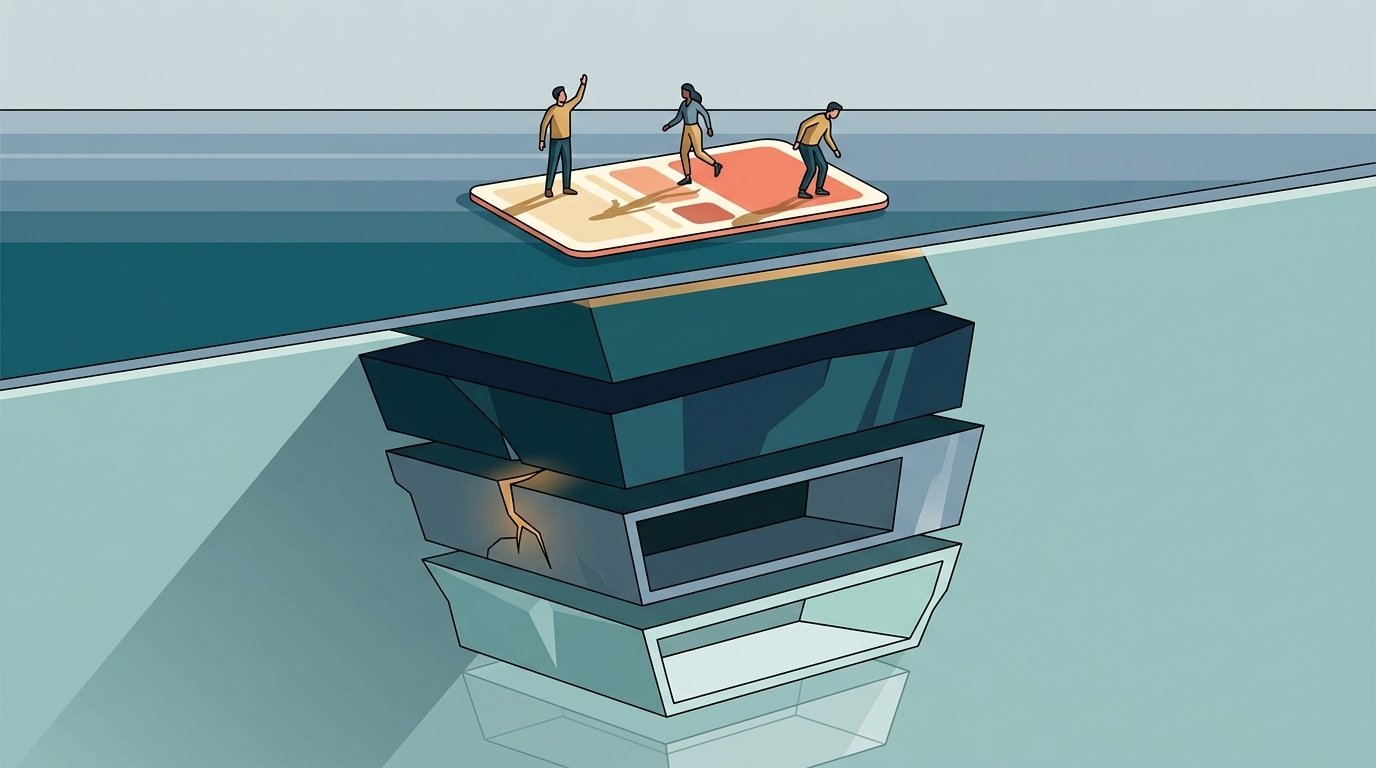
The Best Demo Anyone Had Ever Seen
Vibe coding is a way of building software by describing what you want to an AI in plain English, rather than writing code yourself. The term was coined by Andrej Karpathy (a researcher who co-founded OpenAI and previously led AI at Tesla) in early 2025. You tell the model what you want, it writes the code, and you refine by describing problems rather than fixing them line by line. The model types. You provide the vision.
It works. Brilliantly. For the first layer.

There is a moment in every demo room, physical or digital, where something clicks.
The product loads. It responds. Someone types something and it does the right thing. Faces change. The questions stop. Somebody says “when can we have this?” and everybody else is already nodding.
That moment happened millions of times in 2025 and 2026. It happened with unprecedented frequency because anyone could now create a working, responsive, convincing product in an afternoon.
In February 2026, a man called Moltbook into existence this way. An AI social network (a place for AI agents to interact and post) built without a single line of human-written code. The founder said so publicly. Karpathy praised it. The internet arrived. It loaded. It animated. It responded.
By every measure a normal person would use, it looked completely finished. This is not a new gap. Every industry has this story: what people see and what exists are rarely the same thing. In software, for the first time, that gap just became invisible.
Three days later, a security firm called Wiz (a US cybersecurity company) opened the JavaScript that Moltbook’s server sent to every visitor’s browser. Inside it: a database key (a password to the entire database) sitting in plain view. Moltbook was built on Supabase (a popular cloud database service), which requires Row Level Security (the policy that controls which users can read which rows) to be explicitly switched on. It had not been. Default: everything open to anyone with the key. The key was in the code every visitor downloaded automatically.
A researcher exploited the full breach in under three minutes.
Behind those rows: 4.75 million records. One and a half million API keys (passwords to other connected services). Thirty thousand email addresses. Thousands of private messages (Wiz, 2026).
Three days from launch. Under three minutes to exploit.
The demo had been perfect. The product had never existed.
That gap has a name. And it is not a bug in the tools.
Frontend and Backend Is Not Full-Stack
The misconception at the centre of almost every vibe coding failure is not about the tools.
When a non-technical founder, product manager, or first-time builder thinks “full-stack” (the complete thing, front to back) they picture two layers: the interface the user sees, and the server that powers it. Frontend and backend. The AI builds both. The prototype demonstrates both.
A production-ready product requires all thirteen. Auth & Permissions (controlling who can access what). Security & RLS (the policies that enforce those controls at the database level). Rate Limiting (stopping a single user from overwhelming the system). CI/CD & Version Control (a pipeline of automated steps for updating the product safely without breaking what already works). Error Tracking & Logs (knowing when something fails, how, and why). Availability & Recovery (continuing to run, and returning to normal, when it does not).
None of these appear in a demo. The demo is a performance of layers one and two. The other eleven have no role in it.
And the diagram does not show everything. It shows the technical stack. What it does not show is the design layer (the discipline that determines whether anyone actually wants to use what you built).
A vibe-coded interface assembles functional elements without a design intention running through them. It is like a room furnished from eleven different houses. The chair came from a kitchen, the desk from a bedroom, and the light was designed for a hallway. Each piece works on its own. The room never does. This is not a cosmetic problem. It shows up in conversion rates, churn, and the gut feeling every user has that something is slightly off, before they can name it.
In an audit of twelve production-ready vibe-coded apps, four had live payment credentials or database master keys shipped directly in the front-end JavaScript, visible to anyone who opens the browser’s built-in inspection panel (getautonoma.com, 2026).
These are not edge cases from one bad actor. Moltbook was not even the worst of them.
The PM Trap
Moltbook is the story everyone cites. The Quittr story is the one that matters more.
In September 2025, a habit-tracking app called Quittr launched with AI coding tools. Within ten days it reached one million dollars in revenue. Oprah Winfrey mentioned it. It was the kind of launch that makes investors reach for their phones at midnight.
What no one knew was that Quittr’s Firebase database (the cloud service where it stored all its user data) was publicly readable. Any logged-in user could access the full backend, where the records of more than 600,000 people were stored openly. The records included ages, triggers for behavioural habits, and personal confessions about users’ struggles (Cybernews, 2026).
A security researcher found it and contacted Alex Slater, Quittr’s co-founder, on 10 September 2025. Slater’s response: he would fix it “in the next hour.”
He did not fix it for months.

This is the product manager trap. As of May 2026, 63% of the people building applications with vibe coding tools have no coding background (TechTimes, 2026). The majority of people making build-and-ship decisions about AI-generated products cannot see the eleven layers that are missing. Not because they are careless. Because they have no frame for what is behind the wall.
The security misconfiguration was invisible to him. So was its severity.
The same blindspot hides design failures. A product manager without design experience cannot see that the first few screens of the app are losing most users before they ever reach the product. They cannot see that error messages are written in developer shorthand that no user understands. They cannot see that the mobile layout is technically responsive but requires a precision of thumb movement real users do not have.
A building inspector knows what to look for behind the wall. A designer knows what to look for in a user’s first sixty seconds. Someone who has only ever toured the show home sees neither.
Not a Freak Event
If Moltbook and Quittr were isolated incidents, you could call them bad luck.
In late 2025, Enrichlead (a software product sold on subscription) watched users find a complete paywall bypass within 72 hours of launch, by changing one value in a hidden developer panel built into every web browser. The check that verified whether a user had paid existed only in the front end (the layer the user controls). Anyone could simply remove it (getautonoma.com, 2026).
Also in 2025, Lovable’s AI generated access control logic across 170 production applications (the rules that decide who can touch what) and got it backwards. Users who had logged in were blocked. Everyone else had open access. The AI had implemented the security layer. It had simply inverted it (CVE-2025-48757, a formally recorded software vulnerability).
Amazon’s internal teams, deploying vibe coding tools with experienced engineers, produced four Sev-1 failures (the most critical level of production incident) in ninety days, including a six-hour outage.
And in April 2026, Lovable the platform (used by eight million people, valued at $6.6 billion) ran for forty-eight days with a broken authorisation flaw. Every user’s source code, database credentials, and AI chat histories were readable by any other logged-in user. A bug report was filed. Lovable’s team reviewed it, marked it “intentional behavior,” and closed it without escalation. They fixed it in two hours once the story went public (The Next Web, 2026).
Across independent security testing: 62% of AI-generated code ships with at least one vulnerability (OX Security, 2026). More than 380,000 publicly accessible vibe-coded apps on the open web, 2,000+ actively leaking data, with no attacker required (Red Access, 2026). AI-generated code now causes one in five enterprise security breaches (per industry analysis, 2026). These are not rare edge cases. They are the default outcome of shipping eleven unbuilt layers.
AI-generated code now causes one in five enterprise security breaches. This is the default outcome of shipping eleven unbuilt layers.
Four Failure Modes
These incidents look different. One founder, three days. Another founder, months. A platform, forty-eight days. Amazon, ninety days. But they all fail in the same four ways.
Technical failure is the most documented. Missing authentication, exposed database keys, access rules never configured, or configured backwards. These are fixable. The thirteen-layer framework tells you exactly where to look. Technical failure happens when the layers under the interface are never built by people who know what building them requires.
Design failure is less discussed and equally real. The user journey was never mapped. Error states were never written in language users can act on. Onboarding was never tested against how a real person reads and moves. Mobile “works” but is not designed for how people actually use their thumbs. Users leave products that feel wrong before they can name why. And a non-technical PM cannot see this failure any more than they can see a missing security layer, because they have no frame for what a well-designed product experience looks like from the inside.
Organisational failure is quieter and more consequential. Slater was not negligent. He was operating in a mental model where the demo was the product. When the person making decisions about readiness has never built or designed any of the layers underneath, those layers are permanently invisible to the decision-making process. The same blindspot covers security and design.
Perceptual failure is the one that makes the other three inevitable. It is last on this list, but first in the chain: everything else flows from it. It happens in the demo room. The prototype loads, clicks, and does the right thing. The investor nods. The client says “when can we have this?” The PM says “soon.” Everyone has experienced the same convincing illusion: a working product. What they experienced was two layers of thirteen, with no design system behind it.
Prototypes used to look like prototypes. Now a vibe-coded prototype loads, responds, and delivers the product’s core value proposition completely. The gap between it and a real product is invisible. Invisible gaps are the most expensive kind.
What the Prototype Is Actually For
None of this is an argument against building fast. The speed is real and useful. The tools are improving too: vibe coding platforms are adding authentication scaffolding, security checks, and deployment pipelines. What does not improve with the tools is the mental model that treats a convincing demo as a finished product.
The prototype is the most precise brief you will ever hold.
It communicates to engineers, designers, security specialists, and stakeholders exactly what you are trying to build, with a fidelity that no slide deck or written spec can match. You built the interface. You can demonstrate the flow, the feel, the user journey. You have eliminated the most common cause of failed software projects: the gap between what the people building it imagine and what the people wanting it actually need.
That is where the prototype’s job ends.
Treating it as a brief resolves all four failure modes at once.
It fixes the technical failure, because the brief goes to specialists before launch, not after the breach. It fixes the design failure, because the prototype is handed to a designer who uses it as a reference for the actual design system: the user journey, the error states, the onboarding, the mobile experience, the copy. The prototype shows what is wanted. The designer builds what will actually work. It fixes the organisational failure, because the PM’s role shifts from “is this ready to ship?” to “have the engineers and the designer finished their layers?” Those are questions anyone can ask and verify. And it fixes the perceptual failure, because when the prototype is a brief, the demo room’s question becomes “is this what we want to build?” not “when can we launch this?”
The right workflow: prototype → brief engineers and a designer → engineers build layers 3-13 → designer builds the design system → security review → launch.
The wrong workflow is: prototype → someone who cannot see the gap says “it looks ready” → launch.
Most vibe-coded products that reach production fail. Not because the tool failed. Because nobody in the demo room knew what the demo could not show.
Hand the prototype to an engineer. Hand it to a designer. That is the workflow. Everything else is a demo room where someone who cannot see the gap calls it done.
The Era of Visible Products
There are roughly 380,000 vibe-coded apps on the public internet. More than 2,000 are leaking sensitive data right now (as you read this), with no attacker required. The demo worked. The product never existed.
Most were built by people who never saw past the front end. Most were managed by someone whose entire experience of the product was the demo. Most had a demo room where everyone agreed it was ready, and nobody in the room had the background to know what they could not see.
Amazon used these tools with experienced engineers and still produced four critical failures in ninety days. Lovable built the tools and still ran inverted access control logic in 170 of the apps it generated. When the people who built the tools are running into eleven missing layers, the people using the tools to build their first product certainly will too.
The prototype is extraordinary. It is the best brief you have ever held. It is not the product. I have sat in enough post-breach retrospectives to know the sentence is always the same: nobody in the room knew what to look for. That is not a technical failure. It is a process failure, and it is preventable.
The product is built by the people who know what the demo cannot show: the engineers who build the layers underneath, and the designers who build the system above. Use the prototype to brief them. Then let them work.
- Treat the prototype as a brief for two disciplines, not one. Hand it to an engineer for the technical layers. Hand it to a designer for the product experience: the onboarding, the error states, the mobile layout, the copy, the user journey. Both briefs come from the same prototype. Neither discipline can do the other’s job.
- List your thirteen layers and mark which are actually built. Frontend · APIs & Backend Logic · Database & Storage · Auth & Permissions · Hosting & Deployment · Cloud & Compute · CI/CD & Version Control · Security & RLS · Rate Limiting · Caching & CDN · Load Balancing & Scaling · Error Tracking & Logs · Availability & Recovery. Walk each one. Ask plainly: built, or looks built?
- Open your own front-end code the way a researcher would. Everything your server sends to a visitor’s browser is visible to that visitor. If there is a database key, a payment credential, or a service token in there, someone will find it. This takes ten minutes to check. Do it before you launch.
- Bring in a security engineer and a backend engineer before launch, not after. A security engineer audits for the layer failures that do not appear in demos. A backend engineer confirms that authentication, authorisation, and access rules are correctly implemented: not just present, and not backwards. The review is the gate between a prototype and a product.
The question is never “how fast did they build it?” The question is who built the parts that do not appear in demos, and whether those people were ever in the room.
NWritten byNadim A. MassihAI & Tech StrategistMore articlesQuestions, answered first
Why do most vibe-coded apps fail in production?
Because they ship two layers and call it full-stack. The interface works. The eleven layers between the UI and a secure, stable, scalable product were never built by anyone who knows how to build them. In a 2026 audit of 200+ vibe-coded apps, 62% of AI-generated code ships with at least one vulnerability for exactly this reason (OX Security, 2026).
What does UX/UI failure in a vibe-coded app actually look like?
The interface assembles functional elements without a design system behind them. Buttons are in technically reasonable places, not the places users expect. Error messages are written in developer language users cannot act on. Onboarding functions but was never tested against how a real person reads and moves. Mobile works technically but was never laid out for how people use their thumbs. Users leave products that feel wrong before they can name why, and those users rarely come back.
What is the PM trap?
A non-technical project manager managing a vibe-coded prototype toward production cannot see the eleven missing technical layers or the missing design system, because they have no frame for either. The demo worked. In their mental model, things are mostly working. As of 2026, 63% of people building with vibe coding tools have no coding background (TechTimes, 2026).
Is vibe coding worth using?
Yes, for building the brief. The prototype is an extraordinarily precise communication tool. Use it to brief engineers and a designer. Let them build what the prototype cannot show.
What if I already shipped?
Audit immediately. Start with Auth & Permissions and Security & RLS. Check whether any credentials are in your front-end code. Confirm your database access rules limit each user to their own data. Bring in a security engineer for a pre-incident review. Have a designer walk your onboarding with fresh eyes. Both are faster and cheaper than the failure they prevent.
Sources & references
Moltbook exposed 4.75 million records (1.5M API keys, 30K email addresses, thousands of private messages) via database key in client-side JavaScript. Row Level Security not configured. Exploitable in under three minutes.
Quittr: 600,000 users’ data exposed via publicly readable Firebase database. Records included ages, behavioral triggers, and personal confessions. Co-founder contacted 10 September 2025; fix took months.
62% of AI-generated code ships with at least one security vulnerability.
380,000+ publicly accessible vibe-coded apps on the open web; 2,000+ actively leaking sensitive data. “Default-public is the breach.”
Audit of 12 production-ready vibe-coded apps: 4 had live credentials in front-end code. Enrichlead: subscription bypass found within 72 hours of launch.
Lovable AI-generated access control logic inverted across 170 production applications. Authenticated users blocked; unauthenticated users had access.
Lovable platform: broken authorisation flaw, 48 days. Every user’s source code, database credentials, and AI chat histories readable by any logged-in user. Bug marked “intentional behavior,” not escalated. Fixed in two hours once public.
Lovable: $6.6 billion valuation, approximately eight million users.
63% of vibe coding users have no coding background.
CVEs attributed to AI-written code: 6 (Jan 2026), 15 (Feb 2026), 35 (Mar 2026). True count estimated 5-10× higher.
Developers using AI coding tools complete tasks up to 55% faster (GitHub Copilot study, ~4,800 developers). 62% of AI-generated code ships with at least one security vulnerability (OX Security).
More articles

LLMflation: Why AI Gets Cheaper and Your Bill Keeps Rising
Microsoft cancelled its Claude Code licences after engineers burned through its entire annual AI budget in weeks. How AI cost becomes your fastest-growing line item.
Own Your AI: Why the AI Subscription Model Is Breaking
AI is shifting from a service you subscribe to, to a feature you ship. The companies that own their models will compound. The ones renting will pay twice.

The Last Human Reader: How AI Became Your First Audience
The pages you publish are no longer primarily read by people. They are read first by machines that decide whether to send a visitor your way.

Anyone Can Make It Now: Why Making Things Stopped Being a Competitive Advantage
Google made its film studio free. WPP cut a third of its creative headcount. The tools gap closed. What that means for the people who spent years developing creative skills.
The Second Customer: Your Product Has Two Users Now. One Cannot Read Your Homepage.
AI-sourced traffic to US retail grew 393% in Q1 2026 and now converts 42% better than human traffic. Your product already serves a second user.

The Cheap Code Problem: When Anyone Can Ship Software, What Is Worth Building?
Snap fired a thousand people because AI writes 65% of its code. The hardest problems in software (requirements, judgment, reliability) have not changed.

The Taste Problem: When the Tools Are Equal, Taste Is the Only Edge
When AI can fake polish and effort, the new proof of human presence is specificity, voice, and the visible mark of a real person's perspective.